Rochester to Otford (★★★★☆)
North Downs Way
18th June 2025
Earlier in the year I had begun to walk the North Downs Way - and had walked from Rochester to Dover, via the Canterbury loop.
Now I am back to walk the opposite end of the trail, starting at the same point in Rochester - and then walking round to Farnham to complete the length of the North Downs Way.
And so we once again find myself heading out of Darlington on the 6:31 train - and after a bit of a snooze on the train down to London, head over to St Pancras to get the 9:50 train down to Rochester - allowing me to get on my way and walking at 10:27 (which feels pretty good going, given that I left my bed in the North East of England earlier in the morning).
As I noted before on my previous walk, the train journey from London to Rochester is not the prettiest (most of it is spent in tunnels or passing ports) - but once you do arrive in Rochester, what you find is a very pleasant historic town.
Rochester saw it's first notable growth in the Roman era - with the town becoming a key point on the London to Dover road (along with Canterbury) - and evidence of that Roman Road still exists in the basement of some of the shops in the center of Rochester.
But it also benefited from the Norman Conquest - and this era saw the construction of both the castle and cathedral. And once again one of the notable advantages to Rochester, was it's location on the road to Canterbury and Dover.
The arrival of Chatham Dockyard was another signifcant boost - with this dockyard producing over 500 ships for the Royal Navy across a timespan of 414 years, and employing 10,000 workers at it's peak of operations.
And the town also has a literary claim to fame - as whilst Charles Dickens was born in Portsmouth, he moved as a boy to Chatham (part of Rochester) - and spend much of his earlier youth here, until the family moved to a debtors' prison due as his father's debts spiralled out of control.
In his later years he then moved back into a house to the north west of Rochester (Gad's Hill Place) - and lived here from 1857 until his death in 187.
This days those links with Dover still have a big influence upon Rochester (and those links played a big role in our getting here so fast) - but the shipyards are long gone now.
But on our pre-walk walk through Rochester, we do get to see some of that history as we pass through the pretty centre, and on past the Castle and Cathedral.
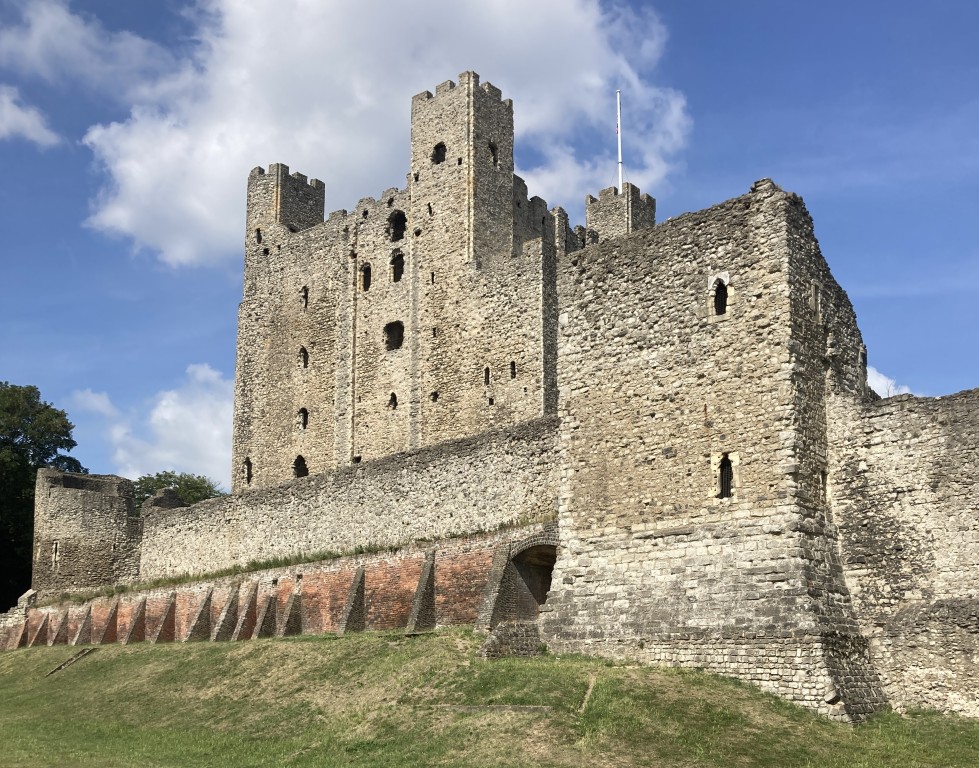
Rochester Castle (on my way to join the North Downs Way)
And once beyond these, we head past the houses until we meet up with the M2 motorway - and the North Downs Way
The last time we came this way, we had gone under the M2, and then turned left to set off towards Dover - but this time we make a right turn, and join up with the motorway as it crosses a bridge over the Medway.
The bridge over the Medway isn't really what you hope for on a countryside walk - with the M2 sitting alongside you on the bridge - but the views over the Medway are good, and it's not as bad as it is made out on other write ups. I found it okay and on a par with a lot of other paths alongside busy road roads.
Rochester grew up because of it's location on the way to Dover or Canterbury - and whilst we can see little of the Roman or medieval influence from here, we do at least have these transport links as a reminder of how important that link to Dover still is today.
But with a last look back to consider what Rochester could be without the M2 sitting overhead (while the Eurostar flies by), it is time to look ahead to some more pleasant walking country.
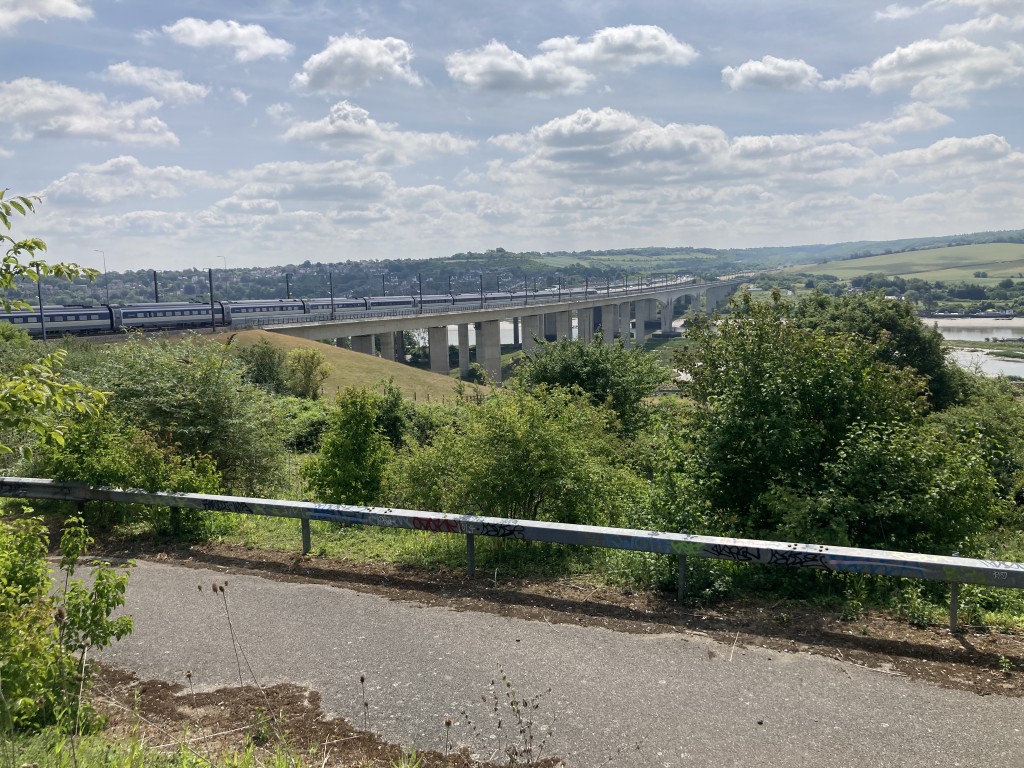
The bridge over the Medway - including a Eurostar train on its way to Paris
For those looking for a place to stay outside of Rochester, the far end of the Medway crossing sits very close to a Premier Inn (reached if you head north-east towards Strood) - but despite it being an extra two miles of walking between the centre of Rochester and the North Downs Way, I would recommend staying in Rochester whilst walking the North Downs Way. It is nicer in the town and worth the extra effort to pay it a visit (and ultimately you are here to explore as well as walk).
But for me there is no stop until Otford - and so I head on in the summer sunshine, walking in the direction of Cuxton - where there is a train station that can offer an alternative start or end point (and if I come back to do this walk, I would start here).
And this section is a very early highlight of the trip, with a mix of crops and wild flowers giving a very pleasant early scene that makes the absolute best of this time of year.
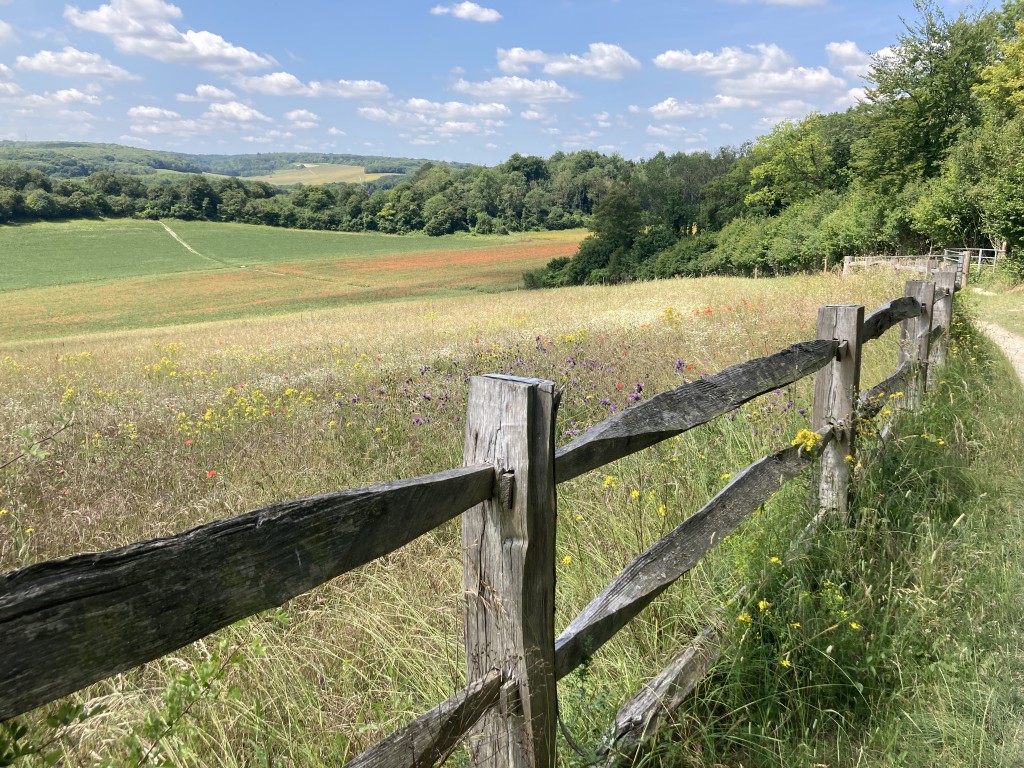
Ranscombe Farm Reserve near Cuxton
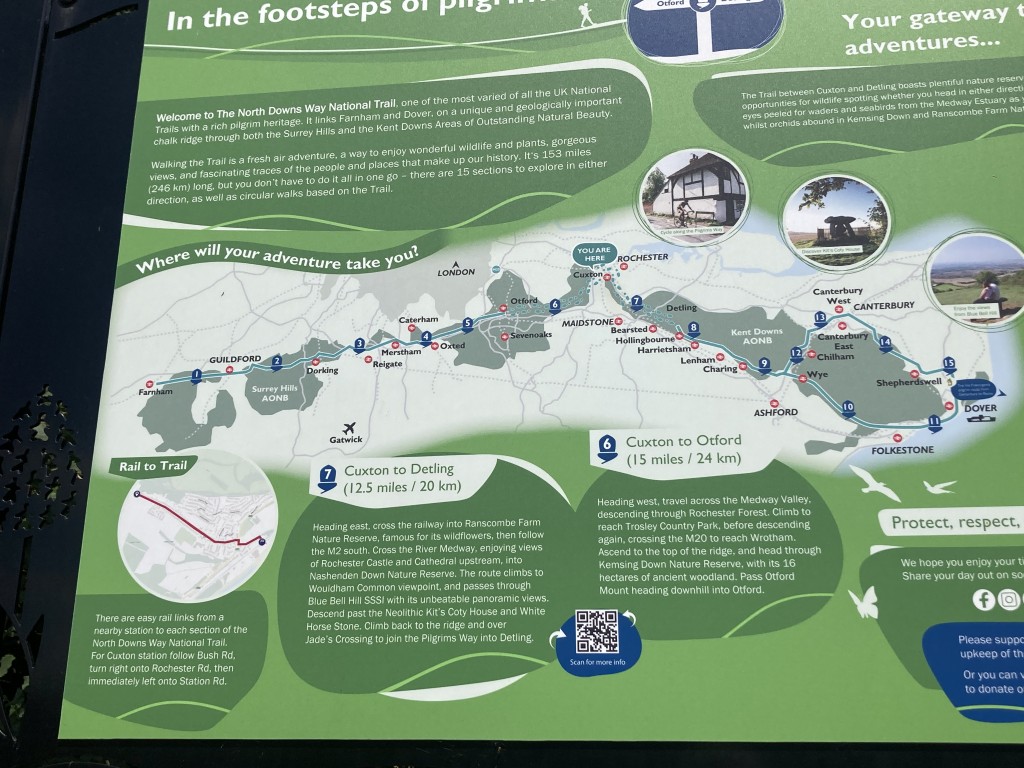
A long way to Farnham - Otford the destination for today
This section heading past Cuxton is a really enjoyable section, and after Ranscombe Farm Reserve, the path winds round Cuxton, before heading into Wingate Wood to begin a more wooded section of the trail.
From here the path continues on through Horseholders Wood and then Greatpark Wood, before the path pops us out just past Holly Hill - offering views to the south and showing off more of that typical chalky downs agriculture.
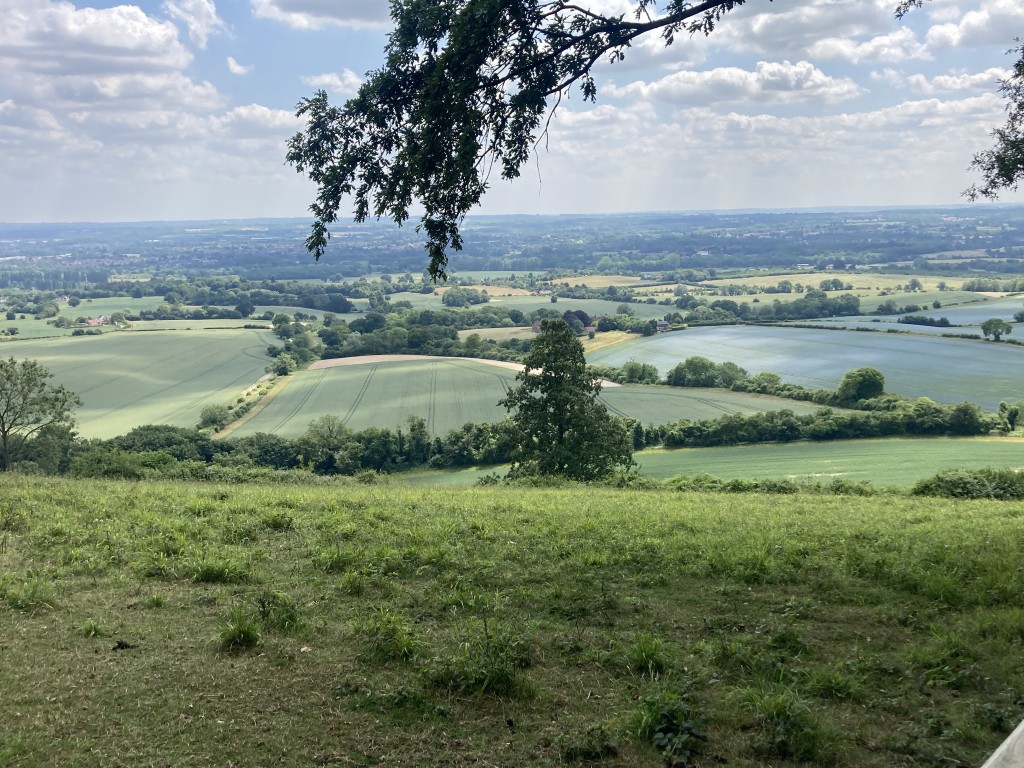
The view out from the downs just after Holly Hill
At this point the path heads down off the ridge and continues on along the base of the valley, giving a new perspective of the surrounding countryside.
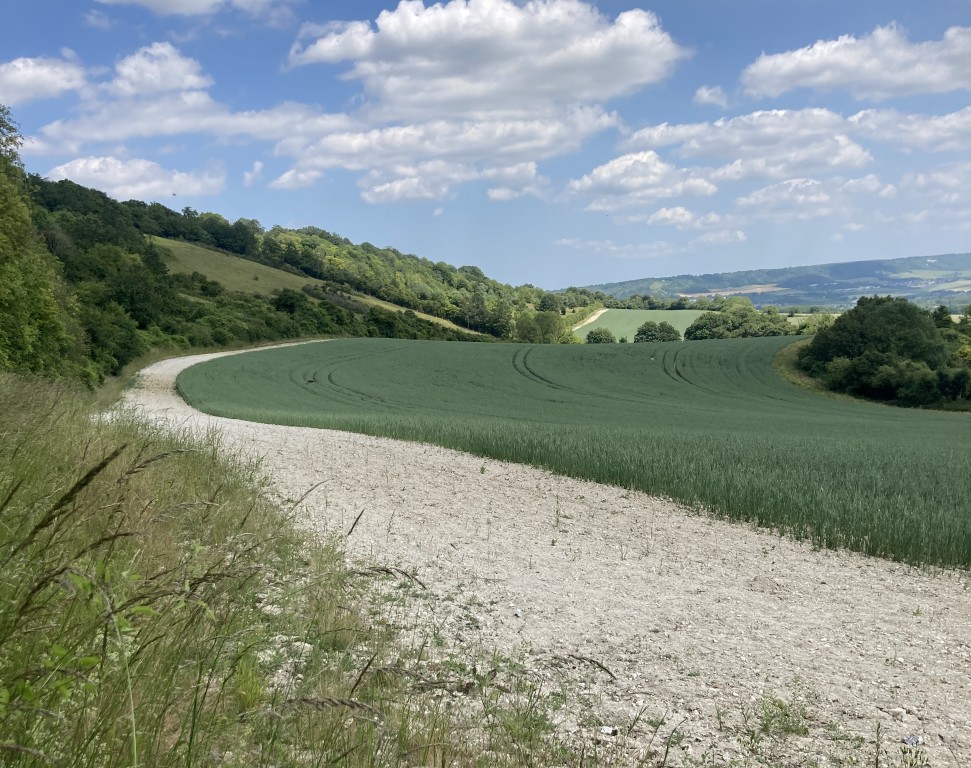
A very typical scene after the descent following Holly Hill
After a fairly brief stretch spent following the fields at the base of the downs, the path joins up with a road, and this marks the point where we need to head back up the ridge, heading into Trosley Country Park.
Here we find ourselves once again walking through woodland and in the heat of the day there is a very welcome bench, at which we're able to rest in the shade.
This rest spot is particularly welcome given that today marks the first of four days of a summer heatwave - with the heatwave projected to end precisely as we complete our walk into Farnham.
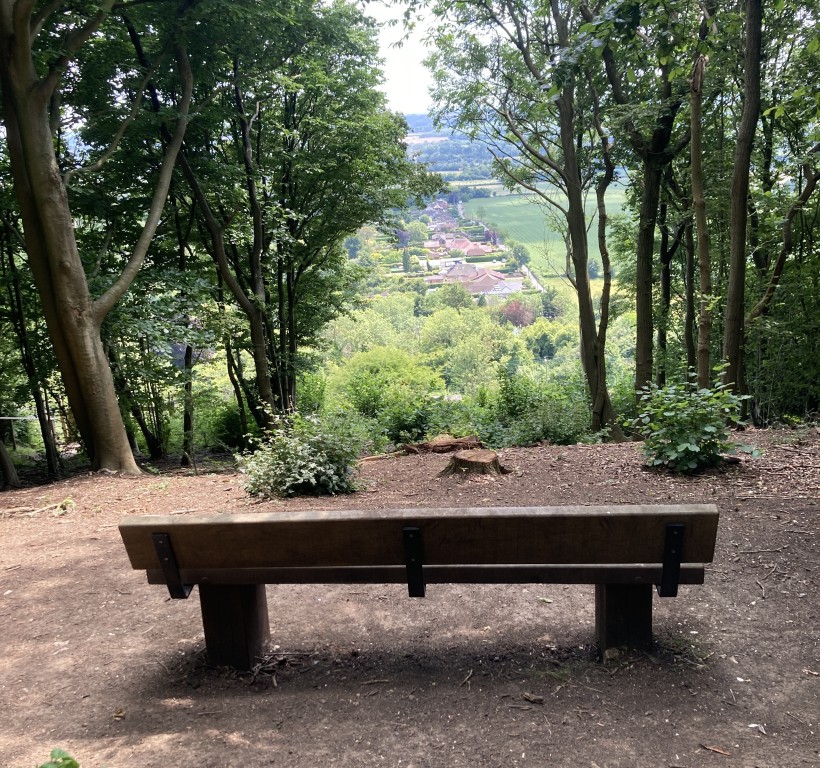
I actually stopped at a less pretty bench, but this would be a nice place to rest too
Having got used to the path being very quiet and being largely my own to occupy, all of a sudden everything has got a lot busier as we head up to the visitors centre.
But the crowds are mostly focused upon this small area surrounding the visitor centre - and as we pass that by, the level of activity drops off as we head back down off the ridge, and join up with a small country road that nevertheless has some fast moving cars driving along it.
Parts of this road allow you swap onto a footpath running parallel to the road (keeping you safe from the speeding cars), but on other sections you have to convince the drivers that it probably isn't worth running you down for the extra 10 seconds it might save them getting home. This is achieved with only some level of success - but ultimately we do not die (which is nice).
I have learned over the years that it helps to start centrally and then move over to one side, but to not do so too fast, as this initial pause in your movement will knock at least a few miles per hour off the speed of an oncoming car.
But eventually we make it to the end of this road, and are rewarded with a fairly complex road crossing at a roundabout.
This busier road will get us over the M20 - and I found it was best to cross at the roundabout itself. Initially I had walked on down to the suggested crossing point, but the sight lines from there are pretty terrible - and the roundabout seemed to be much safer crossing point.
It is a busy road - but if you are patient you will get a gap eventually, so just try and enjoy the scenery (aka a roundabout) and a bit of an enforced rest.
And with that flirtation with the M20 over, we cut into Wrotham - and head through this village and out the far side, on a track that heads along the base of the downs (on the 'Pilgram Way' trackway).
After a brief spell spent walking along this track, we reach a road - and here it is time to head back up to the top of the ridge again, and this climb - whilst a bit roasty-toasty in the heat - gives some good views of the countryside below.
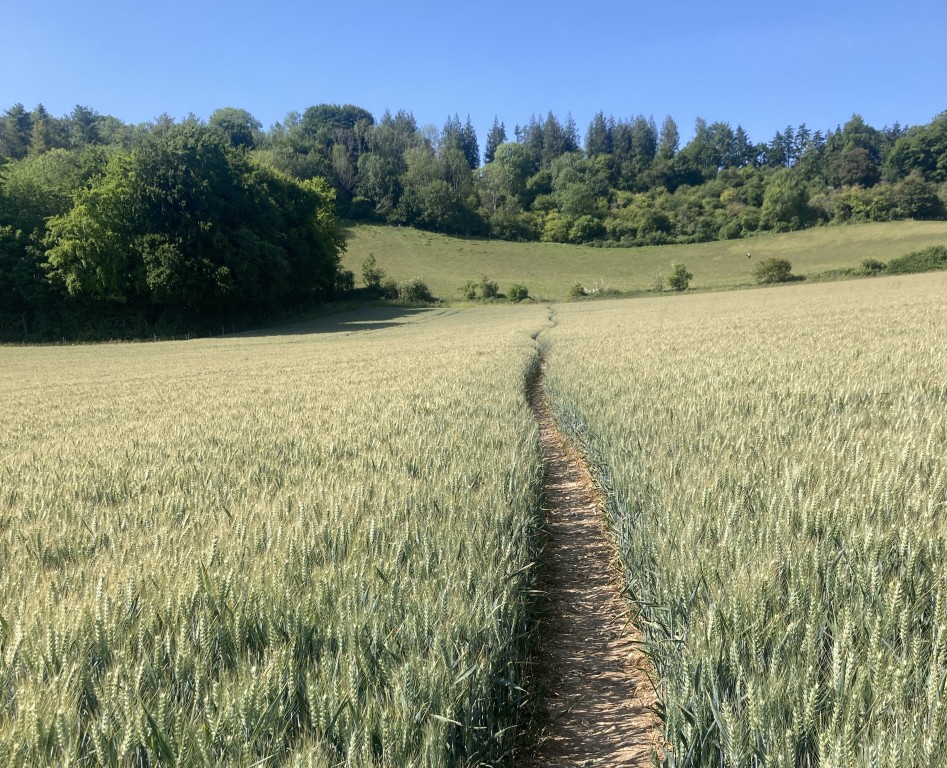
Already looking pretty nice heading up the hill
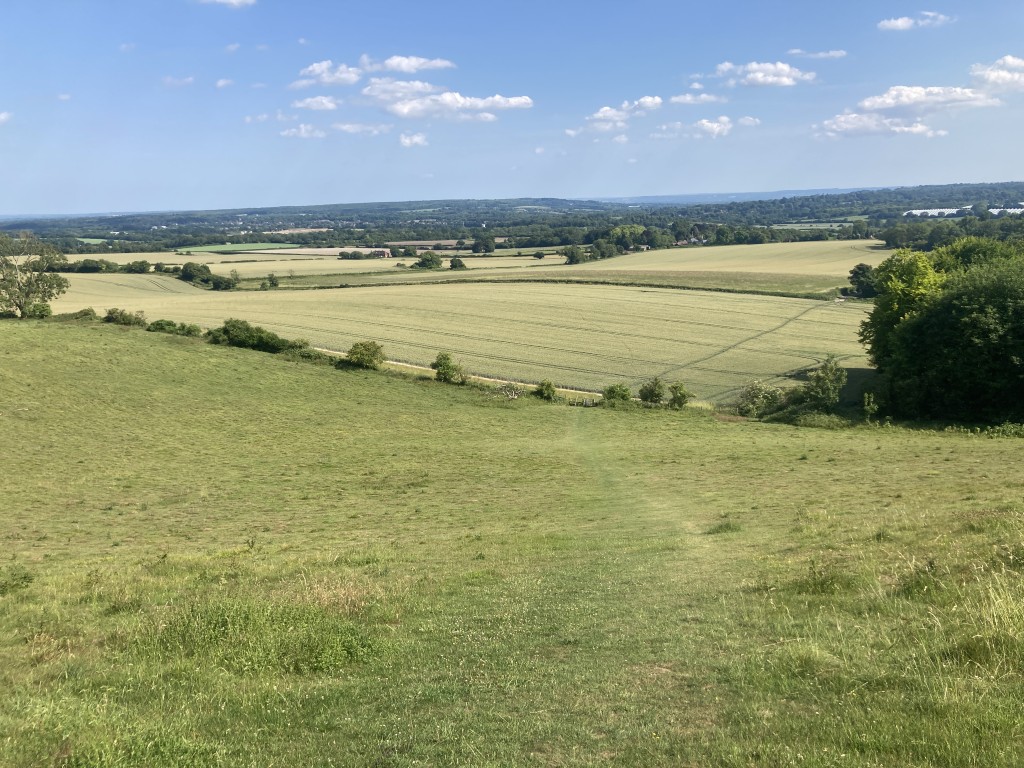
But looking better once you make it up to the top and have a rest
With it being so hot, the climb was heavy work, but the ridge at the top offers up a very nice spot to stop and enjoy the view for a bit.
The path continues on along the top of the ridge - and before long we pass Otford Manor, as we start to draw level with Kemsing in the valley below.
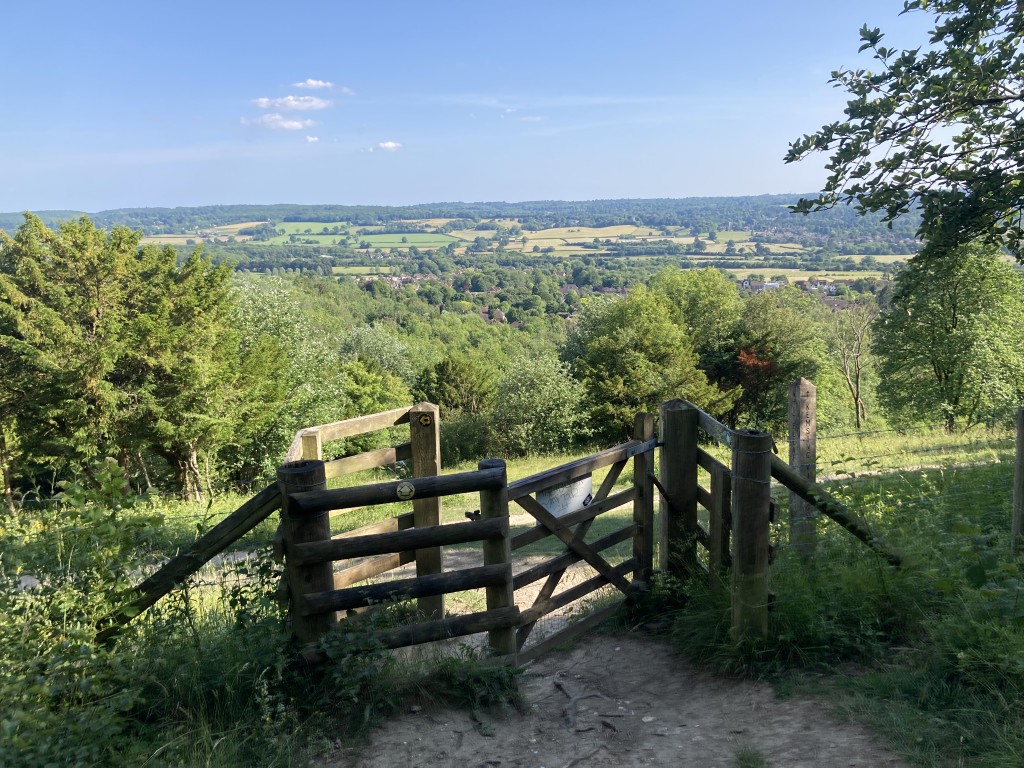
View out over Kemsing
Otford Manor is a particular highlight - with some nice benches and plenty of opportunities for a lazy slow end to the day - pausing to look out over the surrounding countryside.
On the way down into Otford we pass over Otford Mount - which is the site of both an Iron Age Hill Fort and a Bronze Age Bowl Barrow.
But at the bottom of the descent it is the more modern train station that greets us.
For those looking to use public transport to do shorter stages, there are train stations between Rochester and Otford that sit close to the path (and so shorter stints are certainly possible), but this is the first time we have passed very close to a train station since passing Cuxton.
My plan for the evening is to get on a train at Otford and head down into Sevenoaks, where I will stay over - making use of the plentiful food and accommodation options, whilst again exploring one of the peripheral towns.
However, there are train cancellations at Otford with no promise of a fix - and so instead we start the journey down towards Sevenoaks on foot, and stop off to get some food (there are supermarkets and restaurants near Bat & Ball station further along the train line) in the hope that the trains will be fixed by the time we have eaten.
And by the time we have finished our food we are able to head over to Bat & Ball station, and hop on the train into Sevenoaks for the night.
Total Distance: 19.0 miles (17.1 miles on the North Downs Way)
Total Ascent: 2,313ft (2,139ft on the North Downs Way)
Enjoyment Rating: ⭐⭐⭐⭐★ / 5
Click for the adjoining sections of the North Downs Way from Otford to Merstham and from Rochester to Harrietsham.
Disclaimer: This writeup provides a narrative of what to expect rather than a route guide to follow. The route is covered by the 178 and 188 OS Landranger maps - while there is a North Downs Way guidebook which includes OS mapping (links redirect to Amazon). The route is in general well way-marked